
Operation Gladio: Part II – Its Evolution and Phases
Is Operation Gladio dead?

Part II continues the summary of key points from Paul L. Williams’ book – Operation Gladio: The Unholy Alliance Between The Vatican, The CIA, and the Mafia. Part 1 summarised the beginnings of Operation Gladio to understand the intended purpose of its sponsors. In Part II, we track its development through key phases.
After the establishment of Gladio and its first operation in Italy in 1948, I believe the key phases in its evolution are as follows:
The strategy of tension beginning in the late 1960s to counter the rise of leftism in European politics.
Operation Condor in South America to replicate the Europe operation to counter leftism.
Adapting to poppy harvest problems and the pivot from the Golden Triangle to the Golden Crescent following the end of the Vietnam war.
The continuation of Gladio after the end of the Cold War.
I have included a brief postscript on where the Vatican stood in the aftermath of its scandalous involvement in Operation Gladio following the end of the Cold War.
Banking and money-laundering activities are a huge part of the story. I felt it was too big to try to weave into this Part II, so it’s covered in Part III. However, I have mentioned the Bank of Credit and Commerce International (BCCI) scandal later in this Part II as it coincides with the pivot from the Golden Triangle to the Golden Crescent.
Of course this series of articles is no substitute for reading the book by Paul L. Williams – Operation Gladio: The Unholy Alliance Between The Vatican, The CIA, and the Mafia.
The strategy of tension
1969 saw a resurgence of the radical left in Italy and the Western World. This threat to the concentration of wealth in the hands of Operation Gladio’s sponsors led to a new phase of the operation – the strategy of tension.
This entailed the orchestration of false flag terrorism by Gladio units throughout Italy and other major centres where the Left posed a threat, with false attribution to Leftist groups in order to discredit and weaken them in the eyes of the general population.
In March 1978, Aldo Moro, Italy’s new Prime Minister, had just formed a government of national unity bringing together a coalition of Communists, Socialists and Christian Democrats. On his way to the opening of parliament for its first debate, he was kidnapped by Gladio terrorists. Giulio Andreotti, stepped in as acting Prime Minister and immediately blamed the left-wing terror group the Red Brigades. Four years earlier, Moro had been warned in no uncertain terms by Henry Kissinger not to tread the path of rapprochement with the Left, and that if he did, he would, in Kissinger’s words, “pay dearly for it.”[i]
A crisis committee was formed to deal with the hostage negotiation. All the members of the committee were P2 members. The committee never intended to negotiate in good faith for Moro’s release, and Steve Pieczenik, a former US State Department hostage negotiator who claimed that he played a critical role in Moro’s fate, later testified that: “We had to sacrifice Aldo Moro to maintain the stability of Italy.”[ii]
If you read a Britannica entry on the Red Brigades, it states matter-of-factly that “in 1978 the Red Brigades kidnapped and murdered former prime minister Aldo Moro.” What it doesn’t tell you is that on 9 May 1978, the crisis committee forged a memo, attributing it to the Red Brigades, stating that Moro was dead. Williams’ source for this is the Report of the Moro Commission, Rome: 1983, p. 53.[iii] Pieczenik said the memo was leaked to the press in order to prepare the public for the worst. He later testified that “The decision was taken in the fourth week of the kidnapping, when Moro’s letters became desperate and he was about to reveal state secrets.”[iv]
Williams goes into numerous other facts surrounding the kidnapping, which you can assess for yourself if you read his book. If you prefer the blue pill, then read Britannica. But, if you want the red pill, then you’ll need to read authors like Williams.
The Bologna bombing in which 84 people were killed is perhaps the Gladio operation that in the end led to its exposure. Falsely blamed on the Red Brigades, the link to the P2 lodge eventually came out with the discovery of secret P2 documents at a Rome airport. The documents were concealed in the false bottom of a suitcase belonging to the daughter of Licio Gelli, head of the P2 lodge. The documents detailed bold plans for P2 to infiltrate and control all state institutions, and also included a top secret US military dossier published under the authority of the US Army’s chief of staff, General William Westmoreland.[v]
These documents, as Williams explains, were:
“enough to convince judge Felice Casson and his team of investigators that P2 had been involved in the attacks [Bologna and others] and that the secret society was acting as a proxy for the CIA. What’s more the investigators realised that the secret society, acting under orders of U.S. officials, had been initiating acts of terror throughout the Western world, and most particularly in Argentina, under the watchful eye if not the blessing of Jorge Mario Bergoglio, who would ascend to the papal throne as Pope Francis I.”[vi]
Operation Condor – Gladio in South America
Operation Condor, launched in 1969, was in essence the Latin American version of Gladio in Europe. The game plan for Condor had already been developed in the 1950s and early 1960s with the CIA-orchestrated overthrow of the Leftist government in Brazil in 1964. When Peron was returned to power in Argentina in October 1969, he knelt at the feet of the P2 Worshipful Master, Licio Gelli, in recognition of the material support the latter had gained from the CIA for Peron’s political party.
One of the hallmarks of Operation Condor was the ruthless suppression of liberation theology propagated by dissenting Catholic clerics in Latin America. Ironically, ‘dissenting Catholic clerics’ in South America denotes a group of priests who called on Pope Paul VI to fulfil the Church’s moral obligation to “defend the rights of the oppressed” and to uphold a “preferential option for the poor”.
These liberation theology priests became a thorn in the Pope’s side for having the temerity to condemn the Holy See’s alignment with the powerful elite. The Pope responded to their petulant insistence on protecting the poor by unleashing Catholic groups such as Opus Dei and Catholic Action, acting in tandem with the CIA.
When Pinochet initiated his pogrom in Chile, Archbishop Alfonso Lopez Trujillo, general secretary of the Latin American Episcopal Conference, said:
“The military junta came into existence as a response to social and economic chaos. No society can admit a power vacuum. Faced with tensions and disorders, an appeal to power is inevitable.”
When Pinochet was arrested, the Vatican secretary of State, on behalf of the Pope, sent a letter to the British government unabashedly demanding his release.[vii]
During this phase of Operation Gladio, six Panamanian shell companies were established to serve as the first laundry port for the illicit South American trade. Drug lords deposited their cash into these firms, whence they were transported both physically and by wire to banks in Milan, like Banco Ambrosiano. From here, the cash was sent to the Vatican Bank, which took its 15-20% cut, before sending the funds to Swiss bank accounts.[viii]
The Pivot from the Golden Triangle to the Golden Crescent
Up until April 1975, the Golden Triangle in South East Asia had been the centre of the world’s opium production, with Saigon as the gateway to the world’s market. The fall of Saigon in 1975 caused a major disruption to Operation Gladio’s cash cow as the Viet Cong began to adopt anti-drug policies. This was compounded by four years of severe droughts and monsoons, leading to a collapse in the harvest from 600 tonnes to 240 tonnes in 1979. Concerted efforts by the Burmese and Thai governments to eradicate poppy production contributed to the steep decline.[ix]
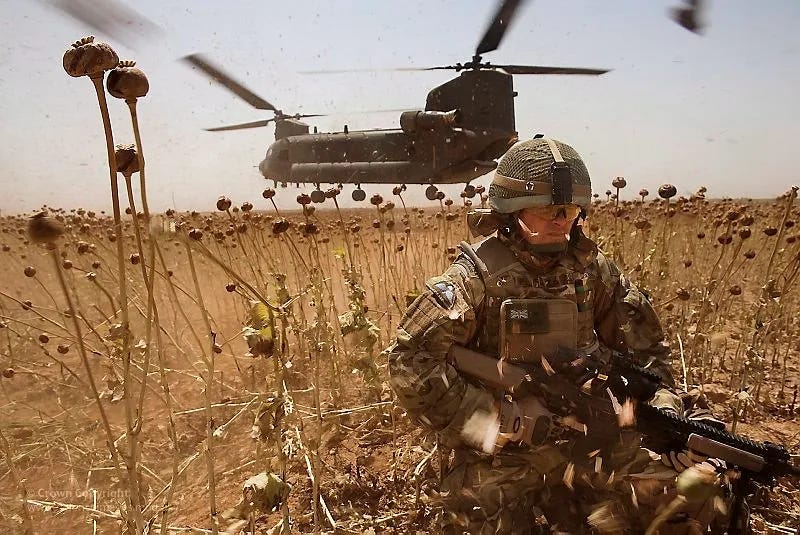
Having lost its connection to the drug lords of South East Asia, the CIA needed to find new sources of opium to fund its covert operations. It set its sights on the Golden Crescent, which is the convergence of the highlands of Afghanistan, Pakistan, and Iran. At that time, Afghanistan was under the rule of a left-leaning, modernist government headed by Nur Mohammad Taraki, who had tried to eradicate poppy production by Pashtun tribes. These two features of the regime – leftist and anti-poppy – stiffened the CIA’s resolve to overthrow that government and, in 1978, it began to back the most unhinged Pashtun tribal leader, Gulbuddin Hekmatyar, who was opposed to the modernist regime.
As Hekmatyar and his mujahideen gained control over poppy farming, heroin production rose from 400 tonnes in 1971 to 1200 tonnes in 1978.[x]
In September 1979, Taraki’s government was overthrown in a bloody coup, and a US-friendly regime led by Hafizullah Amin was installed. This triggered the Soviet invasion of Afghanistan in December 1979.
After the fall of Saigon, and coinciding with the shift of the opium supply to Afghanistan and Pakistan, the CIA set up new money-laundering structures to adapt to the new network. The CIA’s new money-laundering machine, established in Karachi, for the Golden Crescent operations would be the Bank of Credit and Commerce International (BCCI).
In 1991, BCCI collapsed, leaving a $13 billion hole. The Kerry-Brown report to the US Senate’s Committee on Foreign Relations in December 1992 noted that:
“The relationships involving BCCI, the CIA, and members of the United States and foreign intelligence communities have been among the most perplexing aspects of understanding the rise and fall of BCCI. The CIA’s and BCCI’s mutual environments of secrecy have been one obvious obstacle.”[xi]
Having established the Afghan Golden Crescent as the new heroin supply centre, Turkey became a pivotal hub for routing the supply to Western markets. By 1970, the CIA had already comprehensively infiltrated the Turkish intelligence agency, which in turn began leveraging the services of Turkish Gladio units, named the Grey Wolves, and the Turkish underworld (the babas) to replicate the operations that had been perfected in Italy.
In 1980, the Grey Wolves were instrumental in a military coup that toppled Turkey’s Democratic Left Party. President Carter phoned the CIA station chief in Ankara to congratulate him on a job well done.[xii] Williams notes that “the Wolves were so integral to the drugs-for-arms enterprise that it became almost impossible to make a clear-cut distinction between this Gladio unit, the Turkish Mafia, and Turkey’s National Intelligence Operation (MIT), the so-called unofficial arm of the CIA.”[xiii]
Albania became a critical node in the shipment of raw opium along the Balkan route to Italy. The legendary ruthlessness of the Albanian mafia led to the American Gambino family importing them into the US to serve as their enforcers. Williams reports that “by 2004, the FBI announced that the ethnic Albanians had replaced La Cosa Nostra as the ‘leading crime outfit in the United States.’”[xiv]
Perhaps true, but only if you remove the CIA and the oligarchy it works for from the equation.
The Cold War ends. Operation Gladio is dead, long live Operation Gladio
In 1988, as the Soviet withdrawal from Afghanistan got underway, Operation Gladio in Western Europe came to an end. By 1990, Mexico had become the leading source of cocaine for the US market, along with heroin, marijuana, and methamphetamines, all generating $50 billion a year. The CIA now had a new source of funding to supplement the Turkish and Sicilian trade.
In 1988, as the Soviet withdrawal from Afghanistan got underway, Operation Gladio in Western Europe came to an end. By 1990, Mexico had become the leading source of cocaine for the US market, along with heroin, marijuana, and methamphetamines, all generating $50 billion a year. The CIA now had a new source of funding to supplement the Turkish and Sicilian trade.
With the setting up in Italy of a Gladio Commission, the CIA’s false-flag terror project to discredit left-wing political parties started to make news headlines in Italy and Western Europe. This culminated in the EU parliament passing a resolution condemning Gladio in November 1990.
Former Italian Prime Minister Andreotti was hauled before Italian courts for cooperating with the Mafia and for his involvement in the assassination of a journalist. In 2002, an appeals court in Perugia found him guilty of complicity in the murder and sentenced him to 24 years in prison. The Vatican expressed contempt for the ruling, bizarrely comparing Andreotti to Jesus Christ.[xv] Italy’s Supreme Court overturned the verdict in 2003.
So, did Gladio fold when the Berlin Wall fell? Or, to ask the question differently, did the CIA and their shadow puppeteers decide to turn off the tap from which flowed hundreds of billions of unaccounted cash, generated by the misery of millions of addicts? When put that way, the answer becomes obvious. To understand how Gladio morphed, we need to understand the importance of Turkey and Afghanistan to the CIA.
By the early 1970s, Turkish National intelligence was already, in effect, a branch of the CIA. As discussed, Turkey became a vital hub for the flow of heroin out of the Golden Crescent in Afghanistan and Pakistan, through the Balkans, and on to Sicily for refinement and shipping to Western markets. But there was another factor within Turkish politics that fed a symbiotic relationship between Turkish intelligence and the CIA.
The cold war served to incubate, or reignite, Pan-Turkish ambitions within the Turkish military. Turkey has, and continues to harbour grand geopolitical ambitions to project power across the Central Asian Turkic states, which it sees as an historical and cultural sphere of influence. Currently, this ambition has borne fruit in the Organisation of Turkic States, which includes Turkey, Azerbaijan, Kazakhstan, Uzbekistan, and Kyrgyzstan.
The economic significance of Central Asia to the grand geopolitical designs of the Anglo-American establishment was expressed by Zbigniew Brzezinski, who said in 1998:
“The momentum of Asia’s economic development is already generating massive pressures for the exploration and exploitation of new sources of energy and the Central Asian region and the Caspian Sea basin are known to contain reserves of natural gas and oil that dwarf those of Kuwait, the Gulf of Mexico, or the North Sea.”[xvi]
Needless to say, this creates obvious resource and power projection conflicts with China and Russia. China, recognising the energy importance of Central Asia, initiated the Shanghai Cooperation Organisation (SCO) comprising China, Russia, Kazakhstan, Kyrgyzstan, Tajikistan, and Uzbekistan. Note the crossover between this group and the later group initiated by Turkey to express its Pan-Turkic ambition. Later additions to the SCO are India, Pakistan, Iran, and Belarus.
Turkey itself plays a dual game to gain power for itself while also acting as a US proxy in the region.
In the early 2000s, Turkish intelligence partnered with US intelligence to destabilise Xinjiang, whose restive Muslim Uyghurs were seen as fodder to foment an “East Turkistan” breakaway province. China has countered the policy with state-sponsored mass migration of Han Chinese into the region.
Then there is Turkey’s ongoing battle against the Kurds and the PKK – the embodiment of Kurdish nationalism. Not only are the Kurds a stumbling block to the establishment of a Pan-Turkish sphere of influence across Central Asia, but they also threaten to annex oil-rich territories to establish autonomous Kurdish lands. The Kurds continue to be used as pawns in a power struggle between Turkey, the US-NATO bloc, and to a lesser extent China and Russia.
Regarding the Gladio method, it’s important to stress that covert operations conducted by the CIA and Turkish security elements in Central Asia during the 1990s and subsequently, have been both illegal and illegally funded from the same drug trade that was set up and evolved immediately after the Second World War.[xvii]
So that’s a brief overview of the importance of Turkey to the mutation of Gladio in that region and in Central Asia. What about Afghanistan?
Buoyed by its success in fomenting Islamic fundamentalist groups in Afghanistan to resist the Soviet Union’s military occupation there during the 1980s, the CIA ramped up its operations to radicalise terror groups in the Middle East. To say that this policy is now hidden in plain sight does not do justice to its glaring transparency, as borne out by the dismemberment of Syria. Overnight, the new Syrian president has been transformed from a Specially Designated Global Terrorist with a $10 million US State Department bounty on his head to an international statesman brandishing the UN Security Council’s imprimatur.
The Soviet withdrawal from Afghanistan was followed by two civil wars in which the Taliban emerged victorious in 1996. Immediately after taking Kabul in 1997, Taliban leaders were whisked off to Texas, and wined and dined by Unocal oil executives in an attempt to forge an agreement for a pipeline project through Afghanistan.[xviii] However, the Taliban were also being courted by the Chinese-led SCO and, unable to make up their minds, their indecision became increasingly untenable for US oil interests.
In 1998, while the Taliban were still trying to make up their minds, Amoco and BP merged to create the largest oil company in the world at that time. Williams posits that this resulted in a merger of the House of Rockefeller with the House of Rothschild, inextricably binding the US and Britain economically and politically. I would argue that the Rothschild stake in the US banking cartel, and therefore the US Federal Reserve, had made that family a major stakeholder in US Inc. long before this oil merger.
Nevertheless, a confluence of two factors led to Afghanistan being placed at the top of the list of countries deserving special attention in the War of Terror – oil and drugs. We have touched on the first. Regarding the latter, the Taliban had announced on 27 January 2000 plans to ban poppy production. Between 1976 and 1999, the Afghan opium poppy harvest had grown from 250 tonnes to 4600 tonnes. The Taliban prohibition dropped the harvest to a mere 81 tonnes in 2001. Williams notes that “the situation had to be addressed by the military-industrial complex in a forceful way”.[xix]
While oil and a planned project to reshape the Middle East were certainly causes of the War of Terror, so was heroin, which had become a vital asset to the CIA-corporate-banking nexus. That nexus had been instrumental in bringing the Taliban to power. Its impetuous decision to cut off its sponsors’ cash spigot sealed its demise in October 2001.
Within a year of the invasion, “the poppy crop had rebounded to 3400 tonnes”, and by 2013 it “had climbed to an all-time high of 5,500 tonnes.”
James Corbett’s recent report on the opium crop in Afghanistan highlights a CNN video report in which a mainstream media stooge and a US Marine Corps Lt. Col. both lament how unfortunate it is that the US military’s job in Afghanistan is to protect the poppy harvest. How do these schmucks justify it? Well, those poor Afghan peasants don’t have any other way to make a living and so, until they can find some other way to make ends meet, the opium must flow to maintain stability. This is how the US ‘War on Drugs’ works – it’s a War of Drugs.
Needless to say, the invasion of Iraq allowed Anglo-American oil interests to seize Iraqi oil fields. We certainly cannot discount the National Iranian Oil Company’s (NIOC) unexploited North Pars gas fields as a factor in the inclusion of Iran on the infamous list of seven countries to invade. A pipeline running from North Pars, in the Persian Gulf, to Syria via Iraq would be a welcome boost to the Anglo-American money cartel. China had signed a memorandum of understanding with the NIOC for the development of the North Pars field but pulled out in 2019. Iran thus has the world’s second largest gas reserves after Russia, but is unable to exploit them fully.
Meanwhile in January 2025, Russia’s Gazprom announced plans to build a gas pipeline from Russia to Iran, while also pledging to help it to develop the North Pars fields. It remains to be seen whether the Anglo-American establishment has relinquished its ambition of conquering Iran.
By 2014, hundreds of billions of dollars in proceeds of criminal activity and black ops were being laundered through the world’s leading banks, half of which were located in the US. The author’s stunning and yet hard-to-counter assertion: “Narcodollars became the lifeblood of the nation’s economy.”[xx] A salutary observation when considering the propensity for Western leaders to sanctimoniously complain about corrupt dictators failing to toe the line on some aspect of the West’s neo-colonial policies.
It’s also acutely ironic that finance professionals around the world are regularly subjected to the torture of mandatory anti-money laundering training, which aims to heighten awareness of a level of malfeasance that is miniscule in comparison to the oceans of dirty money flowing through the institutions that pay those professionals to be on the lookout for dirty money.
Whither the Vatican?
Is there any evidence that Vatican officials lined up en masse outside confessional boxes to repent of their sins in Operation Gladio following the fall of the Berlin Wall?
Following Pope John Paul I’s 33-day reign, which ended in what has become, at least for author David Yallop, a murder mystery[xxi], John Paul II sat on the papal throne until his death in April 2005. Williams is scathing in his indictment of his reign:
“It rather resulted in the stabilisation of Vatican Inc. as a financial and political institution. The primary goal of this institution was not the quest and dissemination of spiritual truths in an age of uncertainty, but the perpetuation of its own corporate interests through intrigue, mendacity, theft, and, when the situation demanded, bloodshed.”[xxii]
That statement was accompanied by the author’s customary briefcase of supporting evidence, one example of which was a scandal involving an attempted insurance fraud. The insurance commissioners of five Southern US states “filed a federal lawsuit against the Vatican in accordance with the Racketeer Influenced and Corrupt Organisations (RICO) Act, claiming that the Holy See was involved in a criminal conspiracy to steal the frozen assets of nine insurance companies. The lawsuit claimed damages in excess of 600 million.”[xxiii] The Pope responded by reassuring his colleagues in the Roman Curia that the Vatican was a sovereign state, adding: “Ignore them…It will pass.”
By the close of the first decade of the 21st century, US bishops alone had received complaints that approximately six thousand priests – 5.6% of the country’s Catholic clerics – had sexually abused children. Ten percent of the Roman Catholic priests had been accused of paedophilia, prompting legal activists to urge federal and state attorneys to prosecute clerics under RICO guidelines,[xxiv] effectively treating the Church as a criminal and corrupt organisation, as was the case in the insurance scandal.
In Part III, we will look at some of the more startling evidence Williams presents for the Vatican’s role in the operation, focusing on the rise and fall of central characters tied to the Vatican’s money-laundering operations.
 | A guest post by
|